
It’s not the time to panic; it is the time to get ready.
By Mona Charen, THE BULWARK
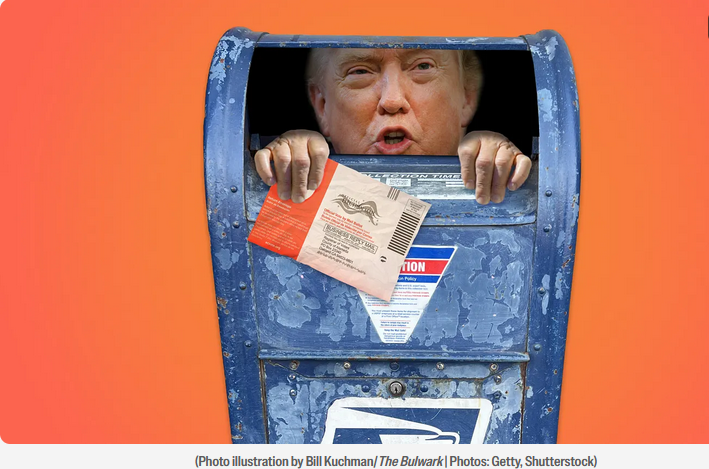
THE SUPREME COURT GAVE US A START this week with what looked, at first glance, like a win for Trump’s efforts to suppress mail-in ballots. But, as Andrew Egger explained, that isn’t quite what happened. In broad outline, the Court stayed a lower court injunction while the legality of Trump’s attempted interference will be decided later. It was a temporary procedural win for Trump, but not a permission slip.
Not yet, anyway. After the 2024 immunity ruling, you’d be ill advised to assume anything about this Court. Until three years ago, it was axiomatic that the president was not above the law. The Roberts Court undermined that key principle. And here too, it seems an open-and-shut case that the Constitution grants power over elections to the Congress and the states, not to the executive branch. But we’ll see.
Still, the Court’s little summer fright is a good reminder that early voting will begin in some places in as little as four weeks, and while the polls and projections look good for Democrats, this is not an ordinary election year. Trump is weakened and flailing, yes, but he remains determined to prevent a free and fair election in November if he possibly can. And he does not lack for lackeys.
The Supreme Court touched on just one of his efforts to subvert the election: his executive order directing the Postal Service to work with states to determine whether voters requesting mail-in ballots were citizens.
There have been other below-the-radar efforts to subvert election security. Since 2025, the Justice Department has demanded voter rolls from forty-eight states. Nearly all states are resisting and the matter is in litigation. Recall that after immigration officers shot and killed Alex Pretti in Minneapolis and feelings were running high, the administration didn’t express regret or apologize. Nor did they announce an investigation. Instead, then-Attorney General Pam Bondi sent Gov. Tim Walz a letter offering to suspend Operation Metro Surge if Minnesota agreed to end its sanctuary city policies and hand over its voter registration rolls and the names and addresses of its Medicaid and SNAP enrollees. And here you thought the ICE raids were all about finding the “worst of the worst.”
Christopher Krebs, director of the Cybersecurity and Infrastructure Security Agency in Trump’s first term, became a target of his wrath because he truthfully testified that the 2020 election was free and fair. In the second term, Trump has gutted the agency Krebs had helmed, denying to states and the federal government key tools to detect foreign election interference. Strange priority for someone who is so consumed with anger at the accusation that he benefited from Russian interference in the 2016 election.
In July, the president announced a major primetime address that would contain a “bombshell” and then rambled incoherently for what seemed like hours about an “unprecedented election security nightmare.” It was China, he claimed, that had actually intervened in the 2020 election. The speech was immediately forgotten, but perhaps it ought not to be. Trump rarely gives primetime speeches. He may have been preparing the ground for some declaration to come.
Meanwhile, Trump instructed Republicans in red states to engage in naked, midcycle gerrymandering. There was no pretense that this was an effort to respond to Democratic gerrymandering. Several states with Democratic majorities like California and Virginia had recently taken steps to limit partisan gerrymandering. Regarding Texas, which was the first state to salute smartly and carry out Trump’s wishes, Trump said: “Just a simple redrawing; we pick up five seats.”
What else could be in store?
Trump has never ruled out using force to affect the election outcome. He attempted it with the Capitol mob in 2021, and even in the past year and a half, he has expressed regret that he didn’t take Lt. Gen. Michael Flynn’s advice and use troops to confiscate every voting machine in the country in 2020. Asked in May whether he would consider using the National Guard or ICE to patrol polling places, he said, “I’d do anything necessary to make sure we have honest elections.”
In February of this year, he told talk-show host (and former deputy director of the FBI) Dan Bongino that Republicans “should take over the voting in at least many—fifteen places. The Republicans ought to nationalize the voting.” And in a meeting with Volodymyr Zelensky, Trump mused that we might pause our elections “if we happen to be in a war with somebody.”
Trump’s factotums have also signaled a certain insouciance about the possibility of sending armed officers to polling places. At his confirmation hearing, Todd Blanche asked: “Why is there an objection to sending ICE to polling stations? Illegals can’t vote. It doesn’t make any sense.”
Feigned confusion to one side, Blanche knows exactly why sending ICE to polling places would be outrageous. After a two-year spree of arrests, manhandling, family separations, detentions, deportations, and even executions of Hispanic-looking people and others, it would be completely understandable that Hispanic citizens might hesitate to exercise their right to vote if they feared being wrongly caught up in an ICE enforcement action. No fewer than 170 American citizens have been stopped, arrested, and detained for days, sometimes in gruesome conditions. In fact, even non-Hispanic Americans would have reason to fear: Neither Renée Good nor Alex Pretti was Hispanic.
Despite their best efforts to hire poorly qualified recruits, ICE still lacks the numbers to perform any kind of nationwide patrol of polling places. There are roughly 95,000 polling places across the country, but at most, ICE might muster 10,000 to 15,000 officers. But those numbers could be more than enough to make a difference in key districts. It’s illegal, under several statutes, to “intimidate, threaten, or coerce” any person “for the purpose of interfering with their right to vote.” But Trump might tell his minions to ignore the law, promising pardons later.
Finally, there is always the possibility that Trump may declare some sort of emergency and attempt to use his powers under the Insurrection Act to federalize the National Guard and deploy it to polling places to supplement ICE. They may calculate that this usurpation would be declared illegal later—but later would be fine if turnout in Democratic areas could be suppressed.
THERE’S ANOTHER POSSIBILITY, too, one that would require more coordination among Republicans willing to do anything for Trump—but we’ve seen that kind of destructive devotion before. If governors and secretaries of state in the right combination of states find reason—however flimsy or farcical—to avoid certifying November’s vote by the time Congress convenes on January 3, it’s possible that the rump House that assembles could have a Republican “majority.” That “majority” could elect a speaker, and that speaker could thereafter delay seating rightfully elected Democrats even after their elections are certified, as Speaker Mike Johnson did for many weeks after a special election in 2025.
The GOP is the party that fought against certifying Joe Biden’s victory. And it is the party that continues to buy into Trump’s Big Lie about the 2020 election having been stolen from him. Nothing should be considered inconceivable.
It’s in our hands. Protect Democracy, the ACLU, the Brennan Center for Justice, and many others are preparing for whatever may come. Protect Democracy offers guidance on your local elections with state-by-state rules. Know the law. Be prepared. Volunteer at a polling place. Take nothing for granted. There is no bottom with MAGA.
.
.
Be the first to comment